
Si estás completamente perdido, visita primero nuestra página.
Living in a small apartment doesn’t mean you can’t grow fresh food.
You don’t need a backyard. You don’t need perfect soil. And you definitely don’t need years of gardening experience.
With a small hydroponic system, you can grow herbs, lettuce, and even some fruits indoors using water, nutrients, light, and a little patience.
The best part?
You can start small.
Many beginners make the mistake of buying too much equipment, choosing complicated systems, or trying to grow everything at once. That usually leads to confusion, wasted money, and plants that don’t survive.
This guide takes a simpler approach.
You’ll learn what hydroponics actually is, how it works, which systems are easiest for beginners, what you can grow in a small space, what equipment you really need, and which common mistakes you should avoid.
By the end, you’ll have a clear idea of how to start your first indoor hydroponic garden without making things unnecessarily complicated.
Let’s start with the basics.
What is Hydroponics and How Does It Work?

Hydroponics is a way of growing plants without traditional soil.
Instead of getting nutrients from soil, plants receive the nutrients they need from water.
That might sound complicated.
It isn’t.
Think of a plant as having two main needs:
- Something to support its roots.
- Access to water, nutrients, oxygen, and light.
Traditional gardening uses soil to provide part of that support and nutrient system.
Hydroponics simply separates these jobs.
The roots can grow in water or in an inert growing medium while a nutrient solution provides the minerals the plant needs.
The plant still needs light.
It still needs water.
It still needs nutrients.
It still needs oxygen.
The difference is that you control these things more directly.
This is one of the biggest advantages of hydroponic gardening.
You are not waiting for the soil to have the right conditions.
You can create those conditions yourself.
How Does a Hydroponic Plant Grow Without Soil?
Plants don’t actually need soil.
They need nutrients.
Soil is simply one way that plants normally access those nutrients.
In a hydroponic system, the nutrients are dissolved into water.
The roots absorb the nutrient-rich water.
At the same time, the plant receives light from the sun or from a grow light.
The leaves use that light to produce energy through photosynthesis.
The result is still the same:
A healthy plant.
The process just happens in a different environment.
Is Hydroponics Difficult?
Not necessarily.
This is where many beginners get confused.
You can build extremely complicated hydroponic systems with pumps, timers, sensors, reservoirs, air stones, tubing, and automated controls.
But you don’t need all of that to start.
A very simple hydroponic setup can be surprisingly easy.
For example, the Kratky method can grow a plant using a container, water, nutrients, and a suitable growing medium.
There is no complicated plumbing.
There is no water pump.
There is no timer.
There is very little equipment.
That makes it especially interesting for beginners.
Once you understand the basics, you can move to more advanced systems.
Why Are People Growing Hydroponically Indoors?
There are several reasons.
The first is space.
You can grow plants on a kitchen counter, shelf, balcony, or small indoor growing area.
The second is control.
You can control the amount of light, water, and nutrients your plants receive.
The third is convenience.
You don’t have to deal with digging, heavy bags of soil, or outdoor weather.
And the fourth is consistency.
When your system is working properly, plants can grow in a controlled environment throughout the year.
That doesn’t mean hydroponics is completely maintenance-free.
It isn’t.
You still need to check your plants.
You still need to monitor the water.
And sometimes your plants will do something strange for absolutely no reason other than apparently enjoying the drama.
But the learning curve is manageable.
Hydroponics vs Soil: Which is Better for Beginners?

Both methods can work.
The better choice depends on your space, budget, goals, and how much control you want.
Traditional soil gardening is familiar and simple.
Hydroponics offers more control and can be excellent for indoor growing.
Here is a simple comparison.
| Feature | Hydroponics | Soil Gardening |
|---|---|---|
| Growing medium | Water or inert medium | Soil |
| Indoor growing | Excellent | Possible |
| Space required | Often very small | Usually more space |
| Water control | High | Lower |
| Nutrient control | High | Depends on soil |
| Mess | Usually low | Can be messy |
| Beginner difficulty | Easy to moderate | Easy |
| Year-round growing | Excellent indoors | Depends on climate |
| Initial equipment | Can require equipment | Usually inexpensive |
| Learning curve | Moderate | Low |
| Best for | Controlled indoor growing | Simple traditional gardening |
Is Hydroponics Better Than Soil?
Not automatically.
That’s important.
Hydroponics isn’t a magic shortcut where you press a button and lettuce appears three days later.
It is simply another way to grow plants.
For some people, hydroponics is better because they live in apartments or don’t have access to good outdoor soil.
For others, traditional gardening is easier and cheaper.
If you enjoy working with soil, have outdoor space, and want to grow large plants, soil may be the better option.
If you want fresh herbs or leafy greens indoors, hydroponics can be an excellent choice.
Why Hydroponics Can Be Great for Apartment Living
Imagine having fresh basil growing beside your kitchen window.
No backyard.
No garden bed.
No digging.
No giant bag of soil sitting in the hallway.
That is where hydroponics becomes especially useful.
Small countertop systems can fit into spaces where traditional gardening simply isn’t practical.
You can grow food in a small apartment while using a fraction of the space you might expect.
For beginners, that convenience is often what makes hydroponics so appealing.
The 5 Best Hydroponic Systems for Beginners (Under $100)

You don’t need an expensive commercial hydroponic setup to get started.
For a beginner, simple is usually better.
Below are five types of beginner-friendly systems that can commonly be found around or below the $100 range, depending on size, features, and seller.
Prices change, so think of these as starting points rather than fixed prices.
1. Kratky Hydroponic System
The Kratky method is one of the simplest ways to start hydroponics.
There is no water pump.
There is no complicated plumbing.
A plant sits above a container of nutrient solution while its roots grow downward.
As the plant consumes water, the water level drops.
This creates an air space that provides oxygen to the roots.
For beginners, this is a great way to understand the basic principles of hydroponics without buying a lot of equipment.
It is particularly useful for lettuce, herbs, and other relatively small plants.
2. Deep Water Culture (DWC) System
Deep Water Culture, commonly called DWC, is another beginner-friendly method.
The plant sits in a net pot above a reservoir of nutrient solution.
The roots grow into the water.
An air pump and air stone are typically used to add oxygen to the water.
DWC is popular because it is simple to understand and can produce strong plant growth when properly managed.
It is also relatively inexpensive to build.
A small DWC setup can be a great next step after learning the basics of the Kratky method.
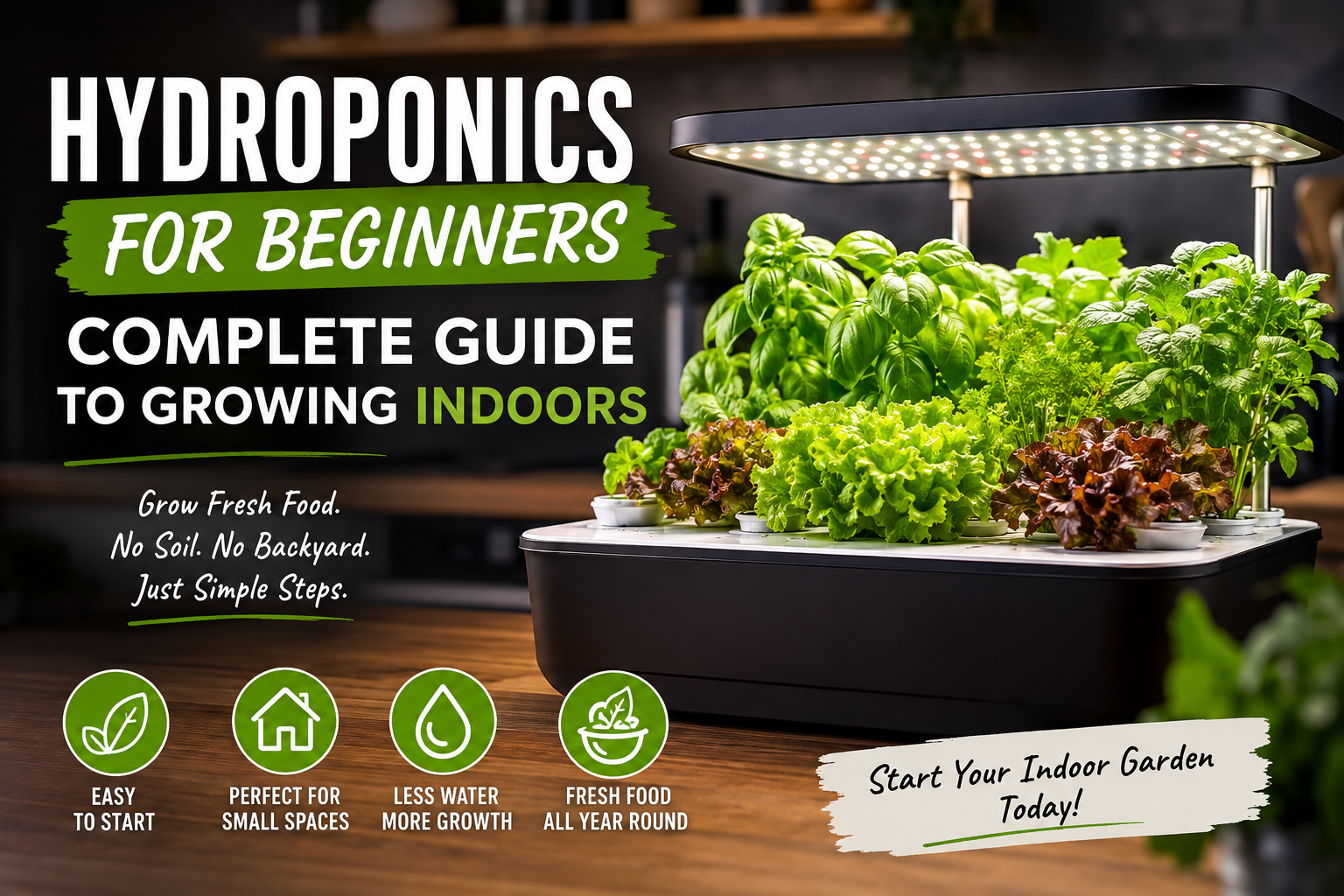
3. Small Countertop Hydroponic Garden
Countertop hydroponic gardens are designed specifically for indoor beginners.
Many include:
- A water reservoir.
- LED grow lights.
- Plant pods.
- A small pump.
- A timer.
- A simple control panel.
This type of system is convenient because most of the major components are already included.
You simply add water, nutrients, and plants.
They are particularly good for kitchens, apartments, and small indoor spaces.
4. Small Ebb and Flow System
An ebb and flow system periodically floods the growing area with nutrient solution and then allows the water to drain back into the reservoir.
A pump and timer control the process.
This system is more complicated than Kratky or basic DWC.
However, small versions can still be beginner-friendly.
They are useful if you want to learn more about active hydroponic systems.
5. Small Drip Hydroponic System
Drip systems deliver nutrient solution directly to the growing medium.
The system normally uses a reservoir, pump, tubing, and small drip emitters.
They can be useful for growing several plants at once.
The main advantage is flexibility.
You can adjust the amount of water delivered to different plants.
The downside?
There are more parts to manage.
That means more opportunities for something to clog, leak, or mysteriously stop working five minutes before you want to show someone your garden.
For a first system, keep it simple.
If you want to see specific product recommendations with real prices and honest pros/cons, check out our Best Hydroponic Systems Under $100 guide.
¿Quieres saber cuál de estos sistemas es el mejor para tu cocina? Consulta aquí nuestras reseñas completas de sistemas.
What Can You Grow in a Small Hydroponic System?

One of the first questions beginners ask is:
“What can I actually grow?”
The answer depends on your system.
Small hydroponic gardens are especially good for compact plants and herbs.
Here are four excellent choices.
Basil
Basil is one of the best plants for beginners.
It grows relatively quickly and works well in small indoor systems.
It also has an obvious advantage.
You can actually eat it.
Fresh basil can be used in pasta, pizza, salads, sandwiches, sauces, and countless other meals.
Regular harvesting can also encourage the plant to produce more growth.
If you are growing your first hydroponic plant, basil is a strong candidate.
Lettuce
Lettuce is another excellent beginner crop.
It doesn’t require a huge amount of space.
It grows relatively quickly.
And you don’t need to wait for a large fruiting plant to mature.
Leafy greens are often among the easiest plants to grow hydroponically.
That makes lettuce a good choice if you want to see results without waiting forever.
Mint
Mint can grow well in hydroponic environments.
It is also a plant you probably don’t want taking over your traditional garden.
Mint has a reputation for spreading aggressively when planted outdoors.
Growing it in a container gives you more control.
In a small hydroponic setup, you can enjoy fresh mint for drinks, desserts, cooking, or tea.
Just remember that mint can grow vigorously.
Give it enough space.
Strawberries
Yes, strawberries can be grown hydroponically.
But they are more demanding than basil or lettuce.
They need sufficient light and proper pollination.
They also need more attention to their growing conditions.
If you’re completely new to hydroponics, start with leafy greens or herbs first.
Once you understand your system, strawberries become a more interesting challenge.
Other Plants You Can Try
As you gain experience, you can experiment with:
- Kale.
- Spinach.
- Cilantro.
- Parsley.
- Chives.
- Oregano.
- Arugula.
- Peppers.
- Tomatoes.
However, larger fruiting plants usually require more space, stronger lighting, and more support.
Start small.
There is no prize for making your first hydroponic garden unnecessarily complicated.
Basic Equipment Checklist for Beginners

Before buying anything, stop for a second.
You don’t need a garage full of equipment.
For a simple indoor hydroponic garden, focus on the essentials.
1. Hydroponic System
This is the foundation.
Choose a system based on the plants you want to grow and the amount of space you have.
For your first setup, simplicity matters more than fancy features.
If you are growing a few herbs, you don’t need a system designed to feed an entire restaurant.
2. Grow Light
Light is extremely important for indoor hydroponics.
A window can provide natural sunlight, but it may not be enough.
Indoor plants need sufficient light to grow properly.
A quality LED grow light can provide consistent lighting when natural sunlight isn’t enough.
Look for a light designed for plant growth rather than simply buying the brightest household lamp you can find.
Your plants don’t care how impressive the lamp looks.
They care about usable light.
3. Hydroponic Nutrients
Plants need nutrients.
Water alone is not enough.
Hydroponic nutrients provide essential elements that plants normally obtain from soil.
Use nutrients designed specifically for hydroponic growing.
Follow the manufacturer’s instructions.
More nutrients do not automatically mean faster growth.
In fact, adding too much can damage your plants.
This is one of the most common beginner mistakes.
4. pH Meter
A pH meter helps you understand the acidity or alkalinity of your nutrient solution.
This sounds technical.
But the basic idea is simple.
Plant roots work best within an appropriate pH range.
If the pH is too high or too low, plants may struggle to absorb certain nutrients even when those nutrients are technically present.
You don’t need to become a chemistry expert.
You just need to learn how to check the number and make small adjustments when necessary.
5. Growing Medium
Some hydroponic systems use growing media to support the plant.
Common options include:
- Rockwool.
- Clay pebbles.
- Coco coir.
- Perlite.
- Specialized hydroponic plugs.
The best option depends on the system.
Don’t randomly combine growing media with a system without understanding how water moves through it.
6. Net Pots
Net pots allow roots to grow through openings while keeping the plant supported.
They are common in DWC and many other hydroponic systems.
They are inexpensive and reusable in many cases.
7. Air Pump and Air Stone
These are especially useful for DWC systems.
The air pump sends air through the air stone.
The air stone creates bubbles.
Those bubbles help increase oxygen in the water.
Healthy roots need oxygen.
This is an easy detail to overlook when you’re focused on water and nutrients.
8. Timer
A timer can control your grow light.
Some systems already include one.
A timer helps maintain a consistent light schedule without requiring you to remember when to turn the lights on and off every day.
Your future self will appreciate this.
Common Mistakes Beginners Make (And How to Avoid Them)
This is probably the most important section in the entire guide.
Hydroponics is not difficult because the basic concepts are complicated.
It becomes difficult when beginners change ten things at once.
Here are the mistakes you should avoid.
Mistake #1: Starting With Too Many Plants
You discover hydroponics.
You get excited.
Suddenly you’re planning lettuce, tomatoes, strawberries, peppers, basil, cucumbers, and possibly a pineapple.
Don’t.
Start with a few plants.
Learn how your system behaves.
Once you’re comfortable, expand.
A small successful garden is much better than a huge garden that becomes a full-time rescue operation.
Mistake #2: Using Too Much Nutrient
More fertilizer does not mean more growth.
Plants have limits.
Too many nutrients can damage roots and cause nutrient problems.
Follow the nutrient manufacturer’s instructions.
Start conservatively.
Learn how your plants respond.
Mistake #3: Ignoring pH
Beginners often assume that if the water looks clean, everything is fine.
Unfortunately, plants don’t judge water by appearance.
pH affects nutrient availability.
If the pH is outside the appropriate range, plants may show signs of nutrient deficiency even when nutrients are present.
Checking pH regularly can prevent many headaches.
Mistake #4: Not Giving Plants Enough Light
This is extremely common with indoor growing.
A plant sitting near a window may look like it is getting plenty of light.
But indoor light levels can be much lower than what plants receive outdoors.
If your plants become weak, stretched, pale, or unusually small, insufficient light may be part of the problem.
A suitable grow light can make a major difference.
Mistake #5: Forgetting About Oxygen
Roots need oxygen.
This is particularly important in water-based systems.
If you’re using DWC, make sure your air pump and air stone are working properly.
If your system relies on passive oxygenation, make sure the design allows enough air around the roots.
Healthy roots should not be treated like they’re supposed to live underwater in a sealed container.
Mistake #6: Changing Everything at Once
Your plant looks unhealthy.
You panic.
You change the nutrients.
Then the light.
Then the water.
Then the pH.
Then you move the plant.
Now you have no idea which change helped or made things worse.
Instead, make one adjustment at a time when possible.
Observe.
Give the plant time.
Then adjust again if necessary.
Mistake #7: Ignoring the Roots
The leaves get all the attention.
The roots are doing much of the important work.
Check them regularly when your system allows it.
Healthy roots generally have a clean appearance and should not have an unpleasant rotten smell.
If roots look unhealthy, don’t simply add more nutrients.
Investigate the cause.
Possible problems include poor oxygenation, excessive heat, stagnant water, or other environmental issues.
Mistake #8: Letting the Water Get Too Warm
Temperature matters.
Warm water holds less dissolved oxygen than cooler water.
Very warm conditions can also encourage unwanted microorganisms.
Keep your reservoir away from direct heat sources and monitor the environment around your plants.
You don’t need a laboratory.
You just need reasonable conditions.
Mistake #9: Never Cleaning the System
Hydroponic systems need cleaning.
Old plant material, algae, mineral buildup, and other debris can create problems.
Clean your equipment between growing cycles.
Keep your reservoir and components in good condition.
A clean system is easier to manage.
Mistake #10: Expecting Perfect Plants Immediately
This might be the biggest mistake of all.
Your first hydroponic garden is a learning project.
Some plants may grow beautifully.
Others may struggle.
You may accidentally overfeed a plant.
You may forget to check the water.
You may discover that the grow light you bought isn’t strong enough.
That’s normal.
Every mistake teaches you something.
The goal isn’t perfection.
The goal is getting better with every growing cycle.
How Often Do I Change the Water?
There isn’t one universal answer.
It depends on your system, plant size, reservoir size, temperature, and how quickly the plants are using water and nutrients.
Some simple systems can be topped up regularly and changed periodically.
Other systems may benefit from a more complete reservoir change on a regular schedule.
The important thing is to monitor the water rather than blindly following a single calendar.
Watch the water level.
Check the nutrient solution.
Monitor pH.
Observe the plants.
If the water becomes dirty, develops an unpleasant smell, or your system shows signs of contamination, investigate immediately.
For beginners, following the recommendations provided with your hydroponic nutrients and system is a good starting point.
Do I Need Special Lights?
If you’re growing indoors, you may need supplemental lighting.
Natural sunlight can work if you have a very bright location with enough direct light.
However, many homes don’t provide enough consistent sunlight for healthy plant growth.
That’s where LED grow lights become useful.
A good grow light provides the intensity and spectrum plants need for photosynthesis.
You don’t necessarily need an expensive professional lighting system.
For a small beginner garden, a properly sized LED grow light can be enough.
The important part is matching the light to the size of your growing area.
Too little light is a problem.
But putting an extremely powerful light directly above a tiny herb garden isn’t necessarily better either.
Is Hydroponics Expensive to Run?
It can be surprisingly affordable.
The cost depends on your system.
A simple passive system can use very little electricity because it may not require pumps.
An active system can use electricity for:
- Water pumps.
- Air pumps.
- Grow lights.
- Fans.
- Timers.
- Other equipment.
The grow light is often one of the most noticeable electricity users in a small indoor setup.
The good news is that modern LED grow lights can be relatively efficient.
Your ongoing costs may include:
- Electricity.
- Nutrients.
- Growing media.
- Replacement parts.
- Seeds or plants.
You don’t need to spend hundreds of dollars every month.
A small system with a few herbs or leafy greens can be relatively inexpensive to maintain.
The biggest cost is often the initial setup.
Start with what you actually need.
Then upgrade as your experience grows.
How Much Space Do I Need?
Less than you probably think.
A small countertop system can fit in a kitchen.
A compact vertical system can use wall or floor space efficiently.
A small DWC container can occupy roughly the space of a plant pot, depending on the design.
The important thing is not just floor space.
You also need to consider vertical space.
Plants grow.
Lights need to be positioned at an appropriate distance.
Some plants may need support as they become larger.
Before buying a system, measure the area where you plan to put it.
Then measure it again.
It sounds boring.
It’s better than discovering your beautiful new hydroponic garden doesn’t fit under the cabinet.
How Long Does It Take to Grow Hydroponic Plants?
It depends on the plant.
Leafy greens and herbs can grow relatively quickly.
Fruit-producing plants usually take longer.
Hydroponics can sometimes accelerate growth compared with traditional gardening because plants have direct access to water, nutrients, oxygen, and controlled environmental conditions.
But hydroponics doesn’t remove the biological growth process.
A tomato plant will not become a mature tomato plant overnight because you put it in water.
For beginners, leafy greens and herbs are usually the best choice if you want relatively quick results.
Can I Grow Hydroponics Without Sunlight?
Yes.
That’s one of the biggest advantages of indoor hydroponics.
You can use artificial grow lights instead of relying entirely on sunlight.
This allows you to grow plants in locations that don’t have suitable windows.
However, artificial lighting needs to be strong enough and used consistently.
The exact lighting requirements depend on the plant.
Herbs and leafy greens generally require less intense lighting than demanding fruiting plants.
Can I Use Tap Water?
Sometimes.
Many hydroponic growers use tap water successfully.
But tap water varies greatly from one location to another.
It may contain minerals or other substances that affect your nutrient solution and pH.
If you’re having repeated problems, testing your water can help identify whether your source water is contributing to the issue.
Don’t assume you need expensive purified water from day one.
Start by understanding the water you already have.
Is Hydroponics Worth It for Beginners?
For many people, yes.
Especially if you want to grow indoors.
Hydroponics gives you control over the growing environment and allows you to produce fresh herbs and greens in relatively small spaces.
It also gives you an opportunity to learn about how plants actually grow.
But don’t choose hydroponics because you think it will require zero effort.
It still requires attention.
The difference is that the work is focused more on monitoring water, nutrients, light, and the growing environment rather than digging and managing soil.
If you enjoy experimenting and learning, hydroponics can be incredibly rewarding.
A Simple Hydroponic Setup for Your First Garden
If you’re completely new, here’s a simple approach.
Start with three or four plants.
Basil and lettuce are excellent choices.
Use a small hydroponic system.
Add the appropriate growing medium.
Use hydroponic nutrients according to the manufacturer’s instructions.
Provide adequate light.
Check the water regularly.
Monitor pH if your system requires it.
Watch the plants.
That’s it.
Don’t start by trying to automate everything.
Don’t buy twenty sensors.
Don’t build a NASA control center for four lettuce plants.
Learn the basics first.
Then improve the system.
Your First Week of Hydroponic Growing
The first week is mostly about observation.
Day 1
Set up your system.
Add water and nutrients according to the instructions.
Install your plants or seeds.
Turn on your grow light if you’re using one.
Make sure everything is working.
Day 2–3
Check the plants.
Look at the leaves.
Check the water level.
Make sure pumps and lights are working if your system uses them.
Don’t start changing things just because nothing dramatic has happened yet.
Plants are not microwave meals.
Day 4–5
Continue monitoring.
Look for healthy new growth.
Check for unusual leaf color or signs of stress.
If you’re using a system that requires pH monitoring, check it according to your setup’s recommendations.
Day 6–7
Review your first week.
Did the water level change?
Are the plants growing?
Is the lighting working consistently?
Is anything leaking?
Is there algae?
Are the roots developing properly?
The goal of your first week isn’t to produce a giant harvest.
It’s to understand your system.
The Beginner’s Golden Rule
Keep it simple.
This is the best advice I can give a new hydroponic grower.
You don’t need the most expensive system.
You don’t need every gadget.
You don’t need a greenhouse.
And you don’t need to understand advanced plant science before growing your first basil plant.
Start with a small system.
Grow something easy.
Learn how water and nutrients work.
Learn how to use your light.
Learn how to monitor your plants.
Then expand.
Hydroponics becomes much easier once you stop trying to learn everything at once.
Frequently Asked Questions
How often do I change the water?
It depends on your hydroponic system and the plants you’re growing.
Some systems can be topped up as plants consume water, while others benefit from regular reservoir changes.
Follow the recommendations for your specific system and nutrients.
Also monitor water quality, nutrient concentration, pH, temperature, and plant health.
Do I need special lights?
If your plants don’t receive enough natural sunlight, yes.
A suitable LED grow light is usually the easiest solution for indoor hydroponics.
Choose a light based on the size of your growing area and the plants you’re growing.
Is it expensive to run?
It doesn’t have to be.
A small hydroponic garden can be relatively inexpensive to operate.
Your main ongoing costs are usually electricity, nutrients, growing media, seeds, and replacement parts.
Lighting can be one of the larger electricity expenses.
Can beginners really grow hydroponically?
Absolutely.
Start with easy plants such as lettuce and basil.
Choose a simple system.
Learn the basics.
You don’t need advanced gardening experience.
Can I grow hydroponics in an apartment?
Yes.
In fact, apartments are one of the situations where hydroponics can make a lot of sense.
Small systems can fit on countertops, shelves, balconies, or other compact areas.
Does hydroponics grow plants faster?
Hydroponic plants can grow quickly when their light, nutrients, water, oxygen, temperature, and other conditions are well managed.
However, growth speed depends on the plant and the growing environment.
Hydroponics isn’t automatically faster just because there is no soil.
Do hydroponic plants taste different?
Not necessarily.
Flavor depends on the plant variety, growing conditions, harvest timing, and other factors.
Freshly harvested herbs and greens can taste excellent regardless of whether they were grown in soil or hydroponically.
Is hydroponic food healthy?
Hydroponically grown vegetables can be part of a healthy diet.
Plants still need essential nutrients to grow, and hydroponic systems provide those nutrients through the growing solution.
As with any fresh produce, proper handling and hygiene are important.
Do I need to know chemistry to grow hydroponically?
No.
You don’t need to become a chemist.
You should understand a few basic concepts, such as nutrient concentration and pH, but modern hydroponic products make the process much easier for beginners.
Learn the basics one step at a time.
What is the easiest hydroponic system for a beginner?
The Kratky method and simple Deep Water Culture systems are among the easiest places to start.
Countertop hydroponic gardens are also beginner-friendly because they often combine several components into one system.
Choose the option that matches your space, budget, and willingness to manage equipment.
Conclusion: Start Small and Grow From There
Hydroponics can look complicated from the outside.
Pumps.
Lights.
Nutrients.
pH meters.
Reservoirs.
Growing media.
It sounds like a lot.
But once you break it down, the basic idea is simple.
Give the plant:
Water.
Nutrients.
Oxygen.
Light.
The right environment.
Then let the plant do what plants have been doing for millions of years.
You don’t need a huge garden to grow fresh food.
You don’t need perfect weather.
And you don’t need to be an experienced gardener.
Start with one small system.
Choose easy plants like basil or lettuce.
Learn how your setup works.
Make mistakes.
Fix them.
Then grow a little more.
That’s how you go from a complete beginner to someone who actually knows what they’re doing.
Ready to start?
Check our beginner hydroponic system recommendations and find a simple setup that fits your space, budget, and growing goals.
Your first indoor garden doesn’t have to be perfect.
It just has to start.